Logic Pro Stock Compressors Guide: Hear Every Model Compared
Logic Pro 11 comes with 7 awesome compressors—do you know how they are different from each other and when to use which one?
In this guide, I’ll explain each compressor, diving into its characteristics and the analogue counterpart it’s modelled after, and also provide audio samples—embedded right on this page— so you can compare and contrast all the compressors on:
- vocal,
- high-gain metal rhythm guitars,
- acoustic guitar,
- electric bass guitar,
- drum bus and
- drum room mics.
Keep in mind, the nitty gritty is in the audio comparison section of this article—it’s much more important to understand each compressor’s characteristics and know when to which one than to know what hardware it’s based on.
If you are more of a visual learner, you can watch my video guide below!
-toc-
Each compressor type explained
Platinum Digital
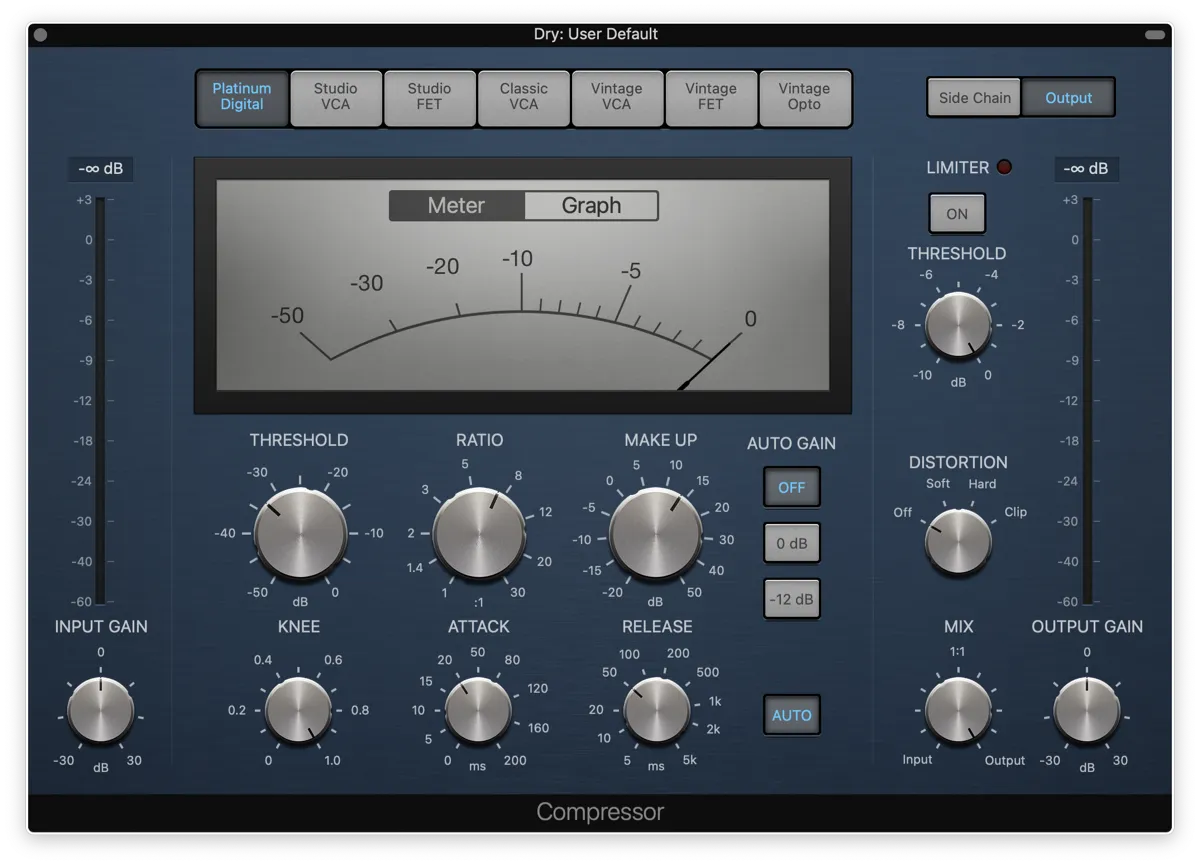
The Platinum Digital compressor is Logic’s basic, plain, vanilla digital compressor. It’s clean and transparent; it shouldn’t have any kind of saturation or colour, and according to the Logic Pro manual, it has a fast transient response, but don’t take its word for it—we will test it out in the audio comparison section.
Studio VCA
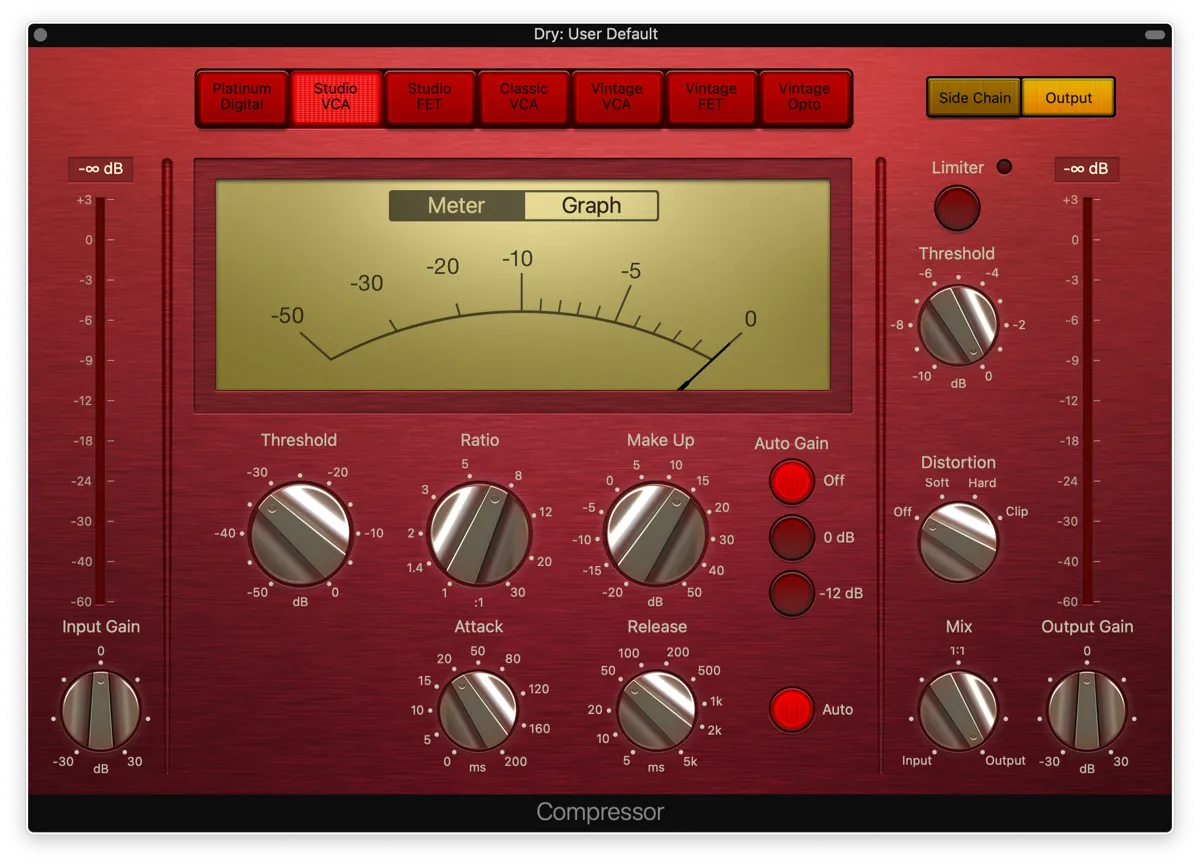
The Studio VCA is very evidently inspired by the Focusrite Red 3 Dual Compressor. Very few compressors out there are red and have those kind of knobs:

VCA just stands for voltage control amplifier—it’s completely useless to know this fact but you could impress some people on the internet with it.
You do want to remember that VCA compressors are generally very versatile because you can set the attack and release to be very fast or very slow.
VCA compressors typically also have all the controls, so besides attack and release, they will have ratio, threshold and sometimes knee. Some even offer more controls for tone shaping, like the API2500.
The Focusrite Red 3 Dual Compressor hardware is known to be very clean and punchy. Its output transformer is also supposed to add some non-linear enhancement to the audio source.
Studio FET
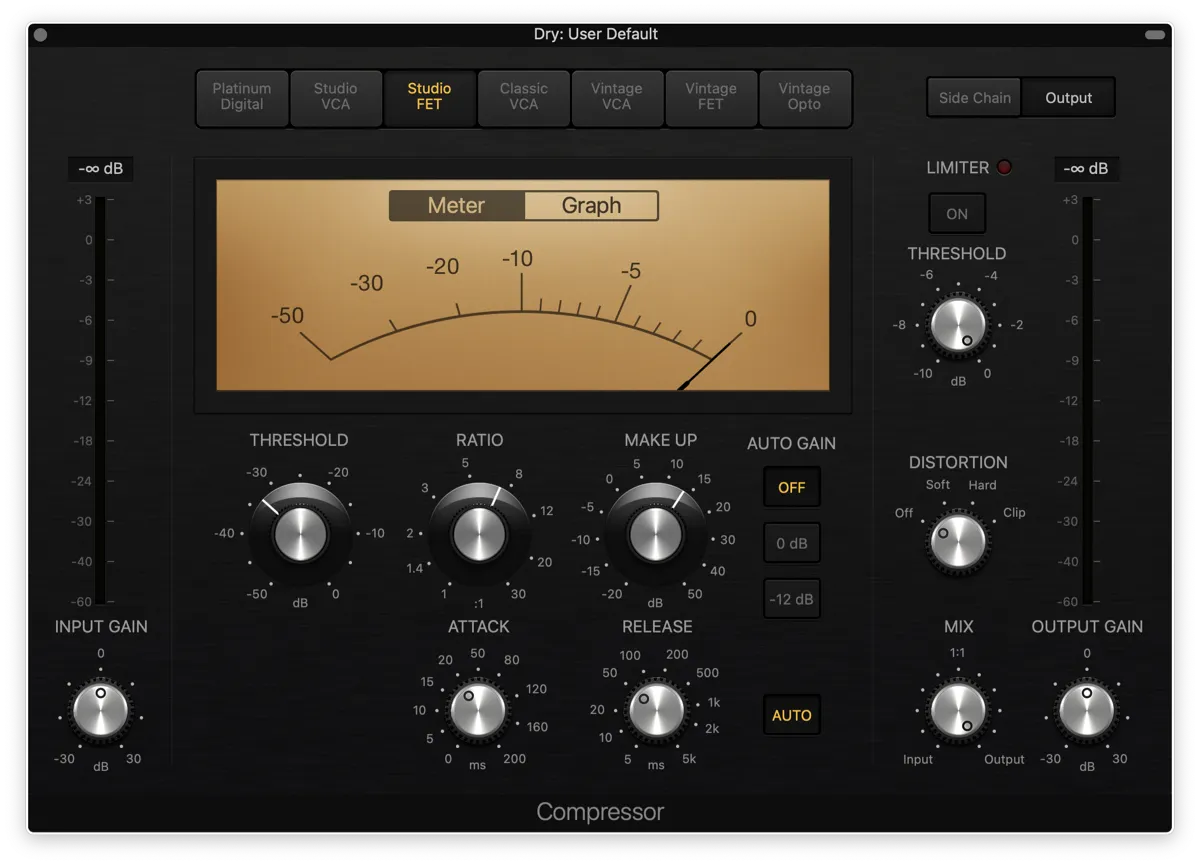
The Studio FET compressor is based on the classic 1176 Blackface, which you have might come across, since there are so many plugin emulations of it.

FET stands for Field Effect Transistor—another completely useless fact you can use to impress people.
What isn’t useless is knowing that the 1176 compressor is known to be very punchy and colourful, and it can have a very fast attack and it adds quite a bit of saturation.
Classic VCA
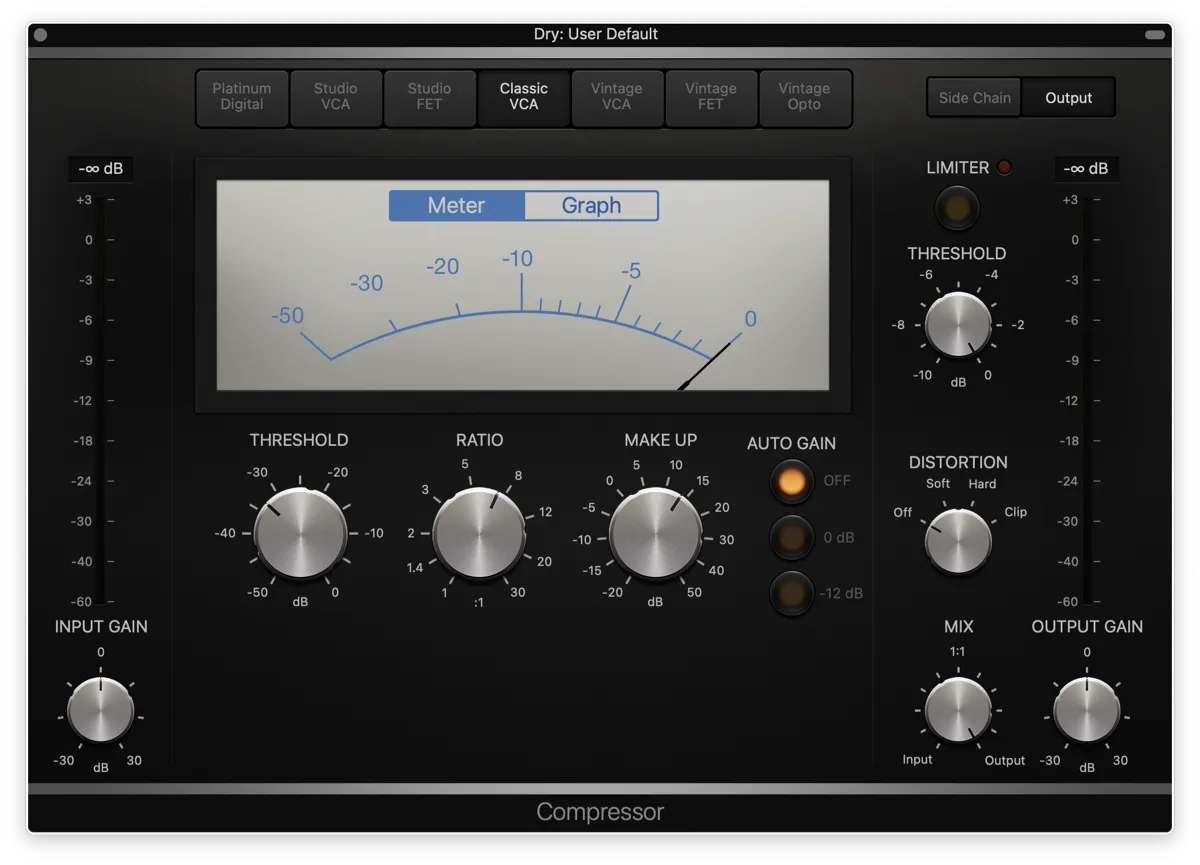
The Classic VCA compressor is based on the dbx 160a.

I know I said earlier that VCA compressors usually have all the controls and are very versatile, but this is a special VCA compressor because it only has a threshold control, a ratio control and an output control, and therefore it’s not as versatile as the typical VCA compressor. The original dbx 160 is known to have a ton of character and colour; it’s not at all clean or transparent. It’s a very fat sounding compressor.
Vintage VCA
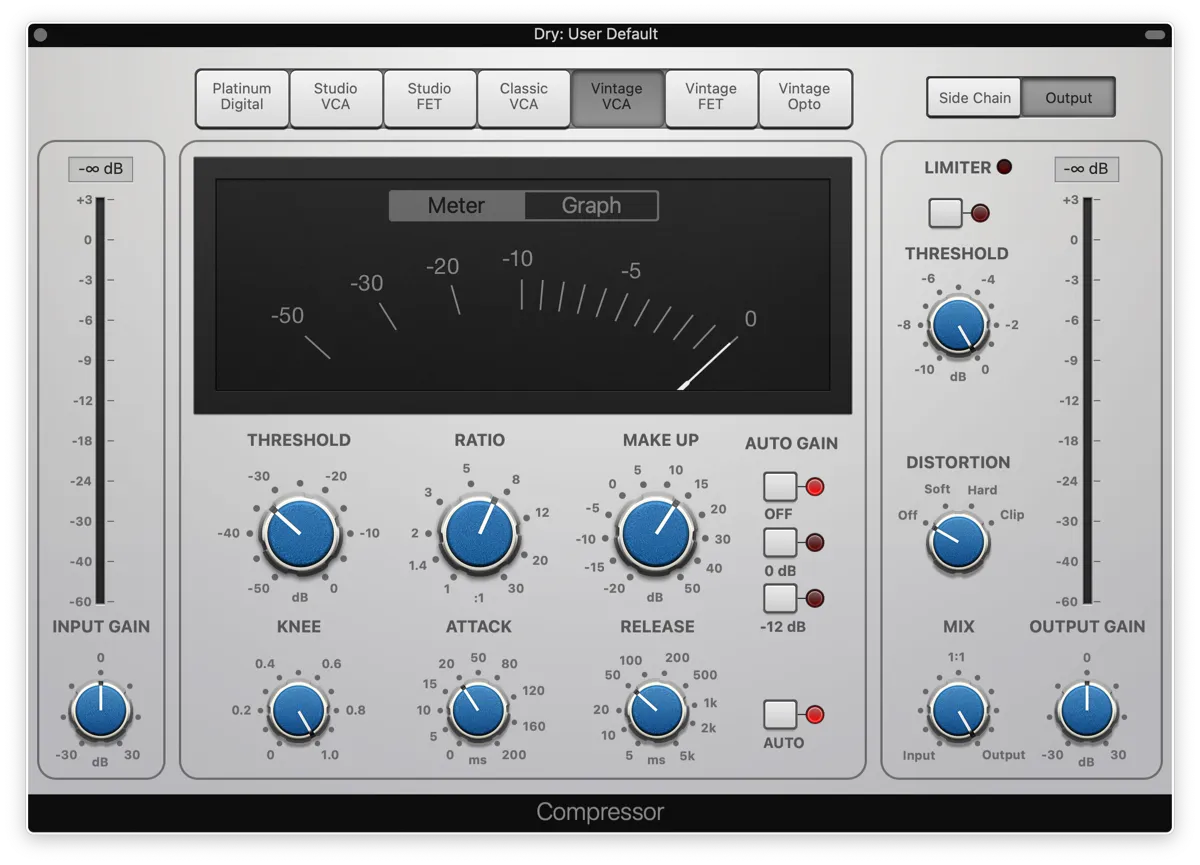
The Vintage VCA compressor is based on the SSL Buss Compressor.

The hardware counterpart is known to be able to glue things together and it’s very punchy. A lot of people love it on the drum bus and the master bus. This is a VCA compressor, so it gives you quite a bit of control.
Vintage FET
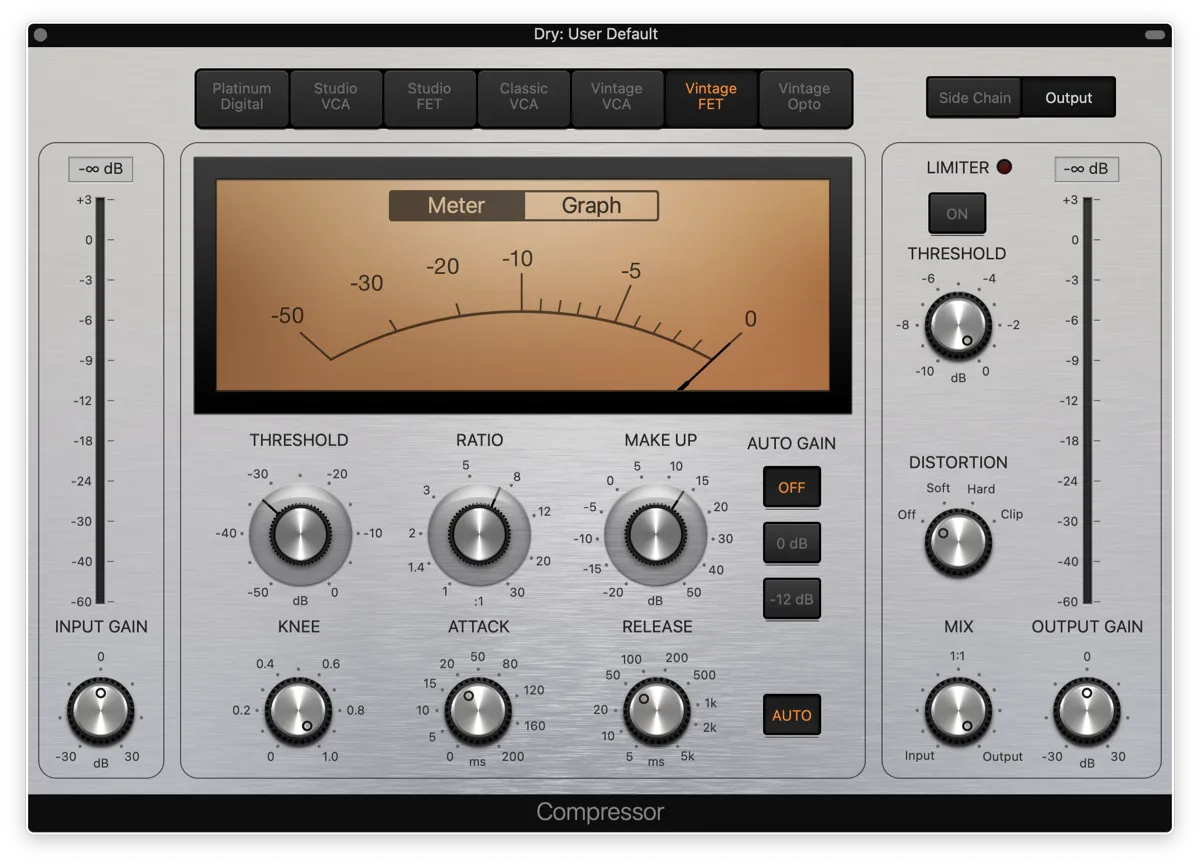
Some say the Vintage FET is based on the 1176 Bluestripe and others say the 1176 Silverface.
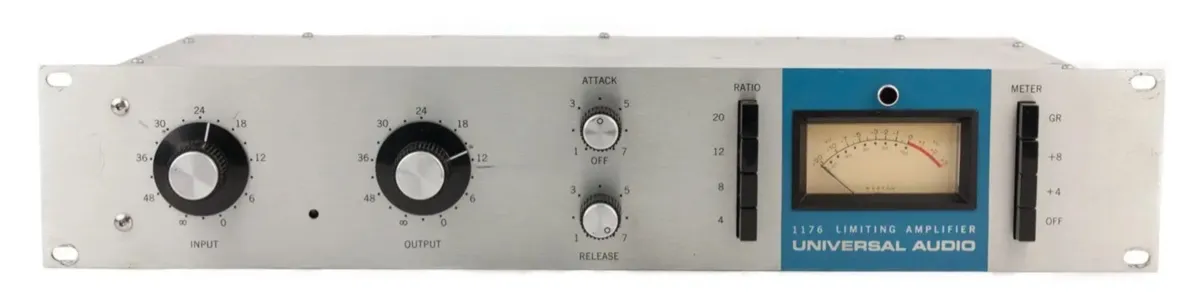
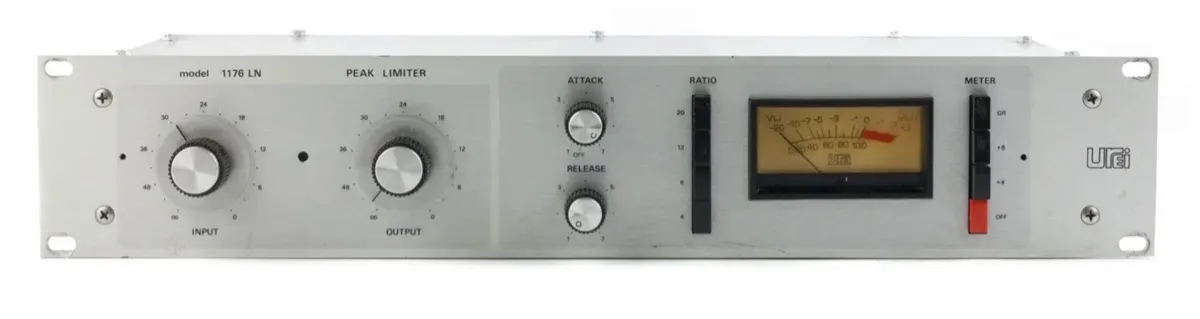
It really doesn’t matter which one of these the plugin is based on. This is an FET compressor very similar to the Studio FET compressor, with slightly different character and colour. In the comparison section of this article, you can compare for yourself how the Classic FET differs from the Vintage FET.
Vintage Opto
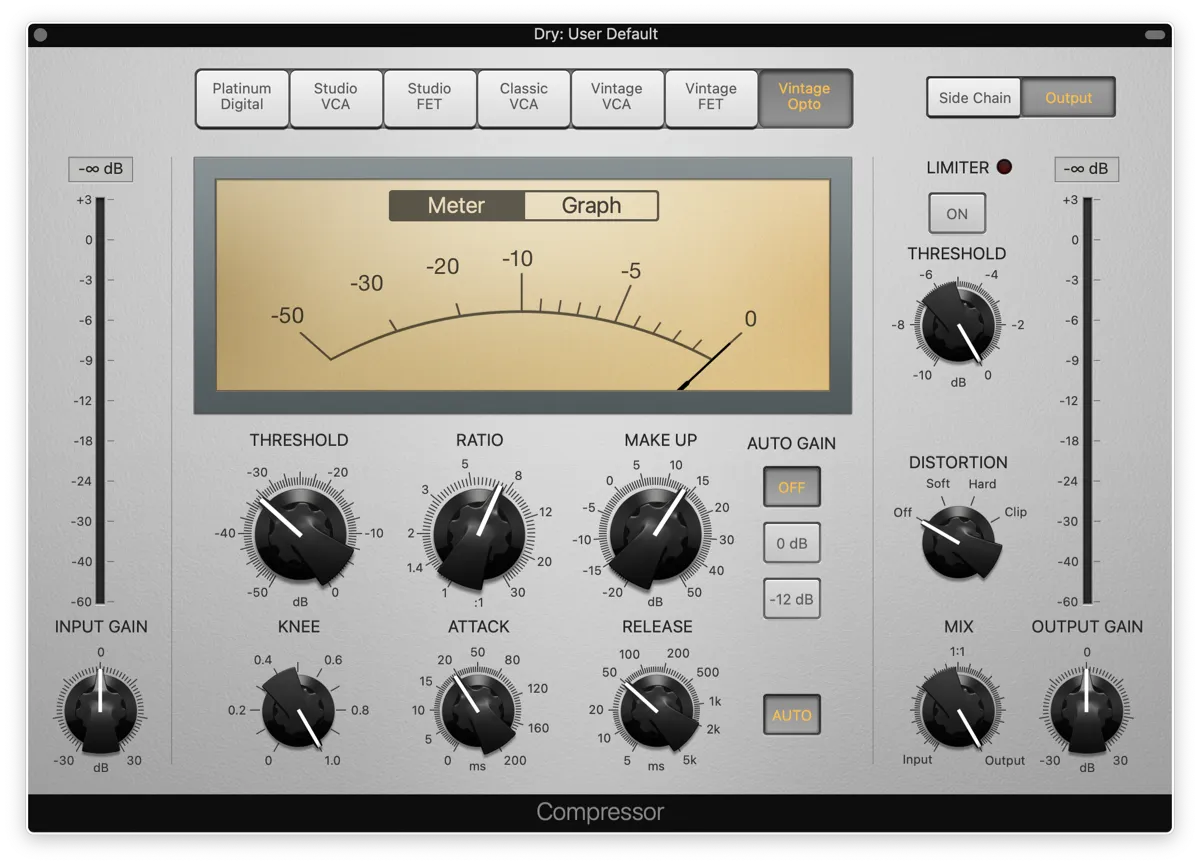
The Vintage Opto compressor is inspired by the Teletronix LA-2A optical compressor.
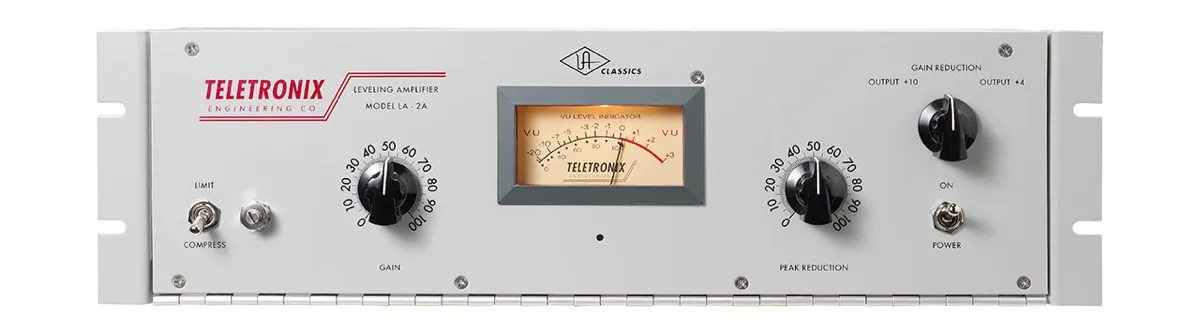
You can easily spot an optical compressor by its lack of controls—it’s main controls are usually just a gain knob and a peak reduction knob (and an output knob but that’s not as important). There’s no control for attack, release or ratio. However, Logic’s version does have all these controls, so I’m assuming it’s not supposed to be an accurate emulation to begin with.
Optical compressors are known to be some of the slowest kind of compressors, but the nonlinear behaviours of the attack and release make people love optical compressors for their musical and smooth compression. Because optical compressors are tube compressors, they also add some nice tube warmth and saturation to the audio.
All Logic Pro stock compressors compared with audio
There’s nothing more important than putting plugins to use and judging solely by how they sound, and NOT by how they are supposed to or marketed to sound.
It doesn’t really matter what hardware compressors the Logic compressors are based on. What matters is knowing how these compressors sound and behave, so you can choose the right one for the right scenario.
I have set up the audio players below so you can easily switch among different compressors and compare them.
Note that for each group of comparisons:
- All compressors were doing the same amount of gain reduction
- All audio samples have been volume-matched
Listen with high quality speakers or headphones.
Jump to different instruments
Vocals
High-gain metal rhythm guitars
Acoustic guitars
Electric bass guitar
Drum bus
Drum room mics
Vocals
In this vocal comparison, I’m using a vocal recording from my friend Alex.
Compressor settings

- Attack: 20 ms
- Release: 51 ms
- Ratio: 8:1
- Knee (when available): 0.5
To my ears, the Studio VCA is a clear winner, and the Platinum Digital sounded the least suitable, with the Classic VCA sounding the second least.
I liked the Studio VCA the most because it was able to drastically reduce the dynamic range of the vocals and really flatten them in a pleasant way.
Even with 20 dB of gain reduction, the vocals sounded really smooth, which is exactly what I’d want for great vocal compression.
The Studio VCA also adds some really nice harmonic saturation to the vocals, making them a bit warmer and thicker.
I thought the Platinum Digital and the Classic VCA sounded the least suitable for this vocal because I could hear very noticeable volume drop whenever there is a loud part, and I could hear the vocal levels fluctuate quite a lot, which is really not ideal for vocal compression.
Aside from the best and the “worst,” the rest of the compressors all sounded pretty similar to one another, and they just sounded okay.
My main problem with them is that they didn’t sound as smooth as I want, and you can sometimes hear the compressor coming in and out.
Of course, with different settings, you might get better results, because if these plugin emulations are anywhere like the hardware counterparts, their attack and release should be all different from one compressor to another, even at the same values. However, for the comparisons to make sense, I had to keep all those variables the same.
High-gain metal rhythm guitars
In this comparison, we have some fast metal guitar riffs that contain a lot of palm mutes. They have plenty of low frequency jumps and are extremely dynamic.
Good compression on metal rhythm guitars typically means reducing these palm mute jumps in an unnoticeable way, while retaining the punch of the palm mutes. We would need a compressor with really fast attack and release for that.
Compressor settings

- Attack: Fastest
- Release: Fastest
- Ratio: 4:1
- Knee (when available): Hardest
This time, quite a few of the compressors sounded equally good, but the Platinum Digital still sounded the least suitable for this case, with the Classic VCA sounding the second least suitable again.
The Studio VCA, Vintage VCA, Vintage FET, and surprisingly—given that optical compressors are usually pretty slow—the Vintage Opto all sounded really transparent, and the compression was barely—if at all—noticeable.
I believe the Studio VCA sounded the cleanest, in that it coloured the audio the least, while the Vintage Opto and the Vintage VCA added a subtle but nice mid-range bite to the guitar tone.
The Platinum Digital and the Classic VCA, however, really struggled to keep up big time, even though I used a really fast attack and the Fastest release. You can really hear the volume drop whenever a palm mute occurs, and that’s not what you would want for your guitars.
Acoustic guitars
Here’s a simple, strummed acoustic guitar track here, and this is what it sounds like unprocessed:
Very well-played and -recorded. I just want to reduce the dynamics of it a bit, just so it’s more together and not all over the place.
Compressor settings

- Attack: 12 ms
- Release: 51 ms
- Ratio: 2:1
- Knee (when available): Medium
- Gain reduction: 5-7 dB
In terms of compression, they are all extremely similar, to the point where if someone showed me these 7 audio clips without telling me they were compressed by 7 different compressors each, I probably wouldn’t be able to tell that was the case at all.
I did notice that some compressors changed the tone of the acoustic guitar very slightly. For example, the Vintage Opto seems to have just little bit more mids compared to the Platinum Digital, but the difference is so subtle that sometimes I don’t even know if it’s just placebo effect.
Electric bass guitar
Here’s a very well-played and -recorded bass track:
The playing is very consistent, but in order for it to work in a metal mix, it’s still way too dynamic, and we are going to use some very heavy compression to pin it down.
The compression I’m looking for is, again, a transparent and smooth one, I don’t want to be able to hear the compression. I just need to really reduce the bass’s dynamic range. I wouldn’t mind some character from the compressor, though.
Compressor settings

- Attack: 8 ms
- Release: 100 ms
- Ratio: 4:1
- Knee (when available): Medium
To my ears, the clear winner is the Platinum Digital. It sounded the most natural, most transparent and the cleanest.
All the other 6 compressors sounded decent, it’s just that none of them sounded as natural as the Platinum Digital, and I didn’t end up liking the colour some of the compressors added to the bass.
Drum bus
The drum bus is always my favourite thing to test compressors on. First, take a listen to the uncompressed version:
It’s a very groovy and dynamic drum track with lots of snare ghost notes and very hard snare hits. We are going to hear how these different compressors will react to the drum transients.
Compressor settings

- Attack: 50 ms
- Release: Fastest
- Ratio: 4:1
- Knee (when available): Hardest
- Gain reducation: 4-6 dB
Immediately, I didn’t like Platinum Digital at all. Its release is just not fast enough and I’m not a fan of the pumping effect it has on the drums, but that’s just me, though—I know some people like some pumping on their drums.
The rest of the compressors are very close. They are all slightly different and I can see someone liking any one of these over the others.
My personal favourite is the Studio VCA and it’s for a few very specific reasons. I really like that it kind of “chopped off” the snare transients a bit like a clipper and in a very pleasantly aggressive way (often an desirable effect in modern metal), while maintaining the clarity and punch of both the snare and the kick.
I like that the cymbals weren’t affected by the snare and kick transients much, and I like that Studio VCA squeezed the whole drum kit in a very clean and transparent way.
This really married the snare and the kick and glued the whole drum kit together.
Generally, I just don’t like it when the snare is sticking out or when the kick gets smeared or saturated, which can be the effect some people are looking for, so it all comes down to personal taste. Some say that makes the drums sound thicker, which is fair. I think the takeaway here is that any of these compressors are good for drum bus compression.
Drum room mics
One of the things mixing engineers love to do when mixing rock or metal drums is to use a compressor to smash the drum rooms and then blend that with the dry signal (or not!). Not every compressor works well for that purpose. Below is the unprocessed drum room mics recording from the same performance as the one above:
As you can hear, this is a very large drum room with a really awesome room sound. For a smashed drum room sound, I’m personally looking for a compressor that can really clip the transients while adding quite a bit of movement or musical pumping; I also would like some pretty mild distortion from the compressor as well. I don’t want it to sound too clean.
Compressor settings

- Attack: 50 ms
- Release: Fastest
- Ratio: 8:1
- Knee (when available): Hardest
- Gain reduction: 10-15 dB
For me, the Platinum Digital was the least suitable for this scenario. It really didn’t handle the transients well. In the meantime, I think all the other 6 compressors sounded really awesome and they all had their own flavour.
The Studio VCA is exceptionally clean, and handles the transients, especially the ones from the kick, really well. I prefer a little bit more saturation so this one won’t be my pick, but it’s damn good.
My favourite would be the Vintage VCA because it clips the transients the way I like, and I like the mild distortion you get from it, but all the other compressors, except for Platinum Digital, are good options for smashing the drum room.
Conclusion
After testing all these compressors out, I came to three conclusions.
First: They are all really good. Whether you are a professional audio engineer or a songwriter, these compressors should be able to satisfy a lot of your needs. Don’t sleep on them just because they are stock plugins.
Second: Never assume a compressor is bad just because it didn’t work on a few sources. The Platinum Digital compressor didn’t sound very good in most of the tests, but it sounded amazing on the bass.
Third: That Studio VCA is such a good compressor on almost everything—certainly a good go-to compressor.
That’s it for this article! Hopefully you now have a better understanding of these 7 compressors in Logic Pro. Feel free to reach out to me if you have any questions. Take a look at my YouTube channel if you are into music and tech.
You are on my personal blog, where I share my thoughts and what I’m currently up to. I no longer use social media, so if you’d like to follow me, you can subscribe via email or RSS feed.
Note: This is not a music production blog, so please don’t subscribe expecting more audio-related posts like this—I don't want to disappoint!